
With over Rs1,500 crore revenues and big-ticket clients like BMW, Honda, Ford and General Motors, Ravi Pandit, the chairman of global automotive software solutions provider KPIT Technologies, has debuted on the world billionaires’ list
Ravi Pandit never really set out to build an automotive software behemoth. That happened as an offshoot.
The gold medallist and chartered accountant Pandit really wanted to build his father’s chartered accountancy business into a global conglomerate along the lines of KPMG and Deloitte.Pandit had just returned to India after completing his master’s programme in management from the illustrious MIT Sloan School of Management, specialising in finance and controls in the late 1970s, when he kickstarted the plan.
“After my master’s in the US, I worked there for a year,” Pandit, currently the chairman and group CEO of KPIT Technologies, a global automotive software solutions provider with a market capitalisation of ₹40,500 crore tells Forbes India. “I had to repay the loans that I had taken for my education.My father made ₹15,000 at the time, and I didn’t come from a wealthy family. Annual costs at MIT amounted to one lakh rupees. As a result, I stayed in the US for an additional year.
That time working for Alexander Grant in Chicago—now Grant Thornton—was very important, and upon his return to the United States, his father’s 1956-founded Kirtane & Pandit firm employed twelve workers.. “There was a desire to build a company which was highly respected for the work that it did,” Pandit, whose name is Shashishekar, explains. “That was the vision, or a passion shared by our entire team. As it happens in the US and unfortunately does not happen in India, many of the accounting companies also do a lot of IT work.”
Companies such as Accenture, which has its roots in accounting firm Arthur Anderson and Deloitte or KPMG, all have an accounting practice history, before they transitioned into newer frontiers of consulting including IT services. “So, while we continued to work in our accounting company, we started building the IT practice,” Pandit says.
 The IT company that Pandit and the other two co-founded is now called KPIT Technologies, with its headquarters located in Pune. Originally called Kirtane & Pandit Information Technology. The company employs over 12,000 people, and has engineering centres in Europe, the USA, Japan, China, Thailand, and India, counting clients such as BMW, Ford, Honda, and General Motors, among many others. The company’s primary focus is on providing embedded software, artificial intelligence, and digital solutions for the automobile and mobility sector, and is amongst the largest software integration partner for the global automotive industry.
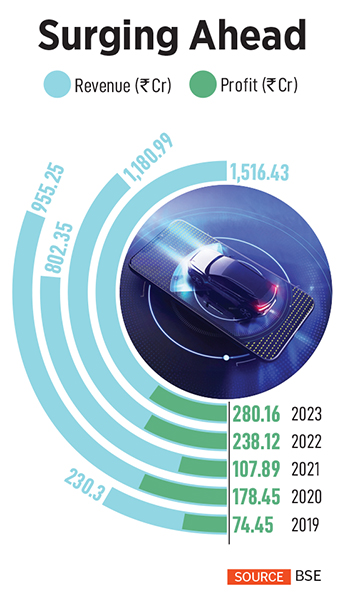
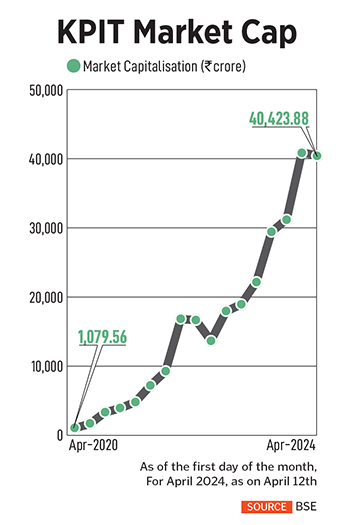
With a net worth of $1, the chairman, Pandit, is a recent addition to Forbes World’s Billionaires List 2024.2 billion as a result of KPIT’s incredible run on the stock exchanges last year. In the last four years, KPIT’s stock has surged over 3,600 percent, and, in the last year alone, surged 82 percent. Last year, KPIT’s revenues stood at ₹1,516 crore, while profits were at ₹280 crore.
Pandit says, “We are in the services business.” There are a few things in the services industry that are absolutely critical to long-term success. One is a very sharp customer focus, the second is that you must be exceptionally good in the work that you do. The third is that you must be faultless in your delivery and none of these things happen unless there is a very strong people focus.”
“The company derives most of its revenue from innovative technology, long-term relationships throughout the product cycle, and cost control exercises through the centralisation of electronic control units (ECUs), and for that, the scalability of the industry is huge,” brokerage firm Geojit said in its recent report. “The growth in the mobility & autonomous space is a priority for customers, and KPIT continues to hold strong domain expertise by adding more capabilities through JV and acquisition.”
Going after it
Much of the phenomenal run on the bourses in the last few years is largely thanks to a well laid-out merger and demerger at KPIT in 2019.
But, before that, in the late 1980s and early 1990s, as Pune established itself as a hub for automobile and tech startups in the country, Pandit and Kishore Patil, a chartered accountant 12 years his junior and working at Kirtane & Pandit, had been brainstorming over Pandit’s desire to take the firm into its next phase of growth. “It’s very hard to take a CA firm global and scale it,” Patil, the CEO & managing director of KPIT Technologies told Forbes India.
“Whether it is accounting or IT, you’re essentially looking at information, processing of the information, and analysing the information to bring out the salient points of the information,” Pandit says about how the pivot to IT came naturally for KPIT. “Around the world, it is a natural progression of accounting. Once you know what you need to analyse, programming is a way of getting there.”
Fortunately for the couple, however, the time was also one of national change, with native IT firms like Infosys and TCS fighting for a piece of the global market and a sharp rise in IT services. The duo then set up a separate arm within the accountancy firm to focus on IT services, after Shirish Patwardhan, an alumnus of IIT-Bombay, also joined them. Patwardhan had already worked with the likes of Oracle, SAP, and TCS in the US. The trio were also joined by Sachin Tikekar, a few years later, as co-founder. The company started out by offering onsite software development services and went on to set up an offshore centre in Pune.
However, it took them some time to realize that a different team and set of funds would be needed for the scale-up.“We realised that product is a different business than services and it requires different kinds of investments,” Patil says. “We decided to leverage what we have built, but the rest of the focus was on the services business.”
As business began to scale up, partially also helped by offering services to its already built-up clients from the accountancy practice, the dot-com bust threw up a big challenge. “We were a sub $10 million company, and a lot of people were telling us that the game was over. That there are 5-6 big companies and what will you do,” Patil says. “We thought let’s get to $100 million and then we can build on that.”
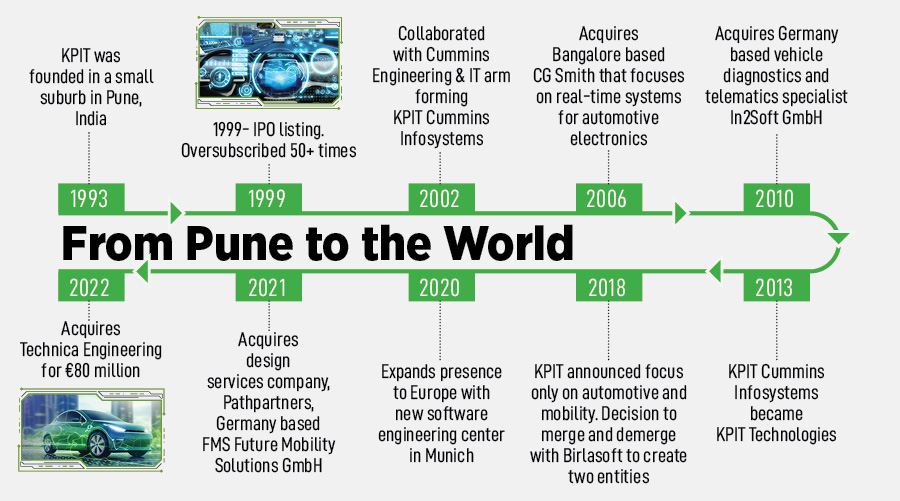
By 1999, KPIT went public, its IPO being oversubscribed some 50 times. But the big turning point, particularly the journey to $100 million, came in 2002 when the company merged with Cummins Infotech, the IT arm of engine maker Cummins India, to form KPIT Cummins Infosystems. Cummins Infotech had been engaged in auto industry-specific software solutions.
The new company focussed largely on the banking, financial services, and insurance (BFSI) and manufacturing verticals. It offered everything from internet consultation, re-engineering and migration, software product development, business intelligence solutions, control automation, and engineering solutions. But, more importantly, what the merger also did was bring KPIT closer into the world of automobiles.
Over the next two decades, the company built up its competencies in engineering, and acquired companies including CG Smith, TVS Harita Mechanical Engineering Team, and in2Soft Diagnostics of Germany, in the automotive solutions space. “The most important point in KPIT life was the Cummins partnership,” says Patil. “Cummins was that client that gave us that anchor and, in four years, we became $100 million. Then, we wanted to scale up to $500 million.”
A merger-demerger affair
After the company started bringing in $100 million a year, KPIT started identifying the next few growth areas and started creating verticals where it might reach its goal of $100 million in sales. By 2009, almost 40 percent of the business still came from Cummins, and the company’s focus areas now included automotive and transportation, manufacturing, which included industrial and life sciences, energy and resources, and utilities. In 2013, KPIT Cummins Infosystems renamed itself to KPIT Technologies.
By 2016, KPIT’s manufacturing segment contributed to 36 percent of its revenues, while its automobile business contributed to 38 percent of the revenues. The key growth areas for the automotive industry then were connectivity, advanced driver assistance systems (ADAS), powertrain, infotainment, and body and chassis. The energy and utilities business accounted for 20 percent of the revenues while others contributed 7 percent. About 68 percent of the revenues came from the US.
 By 2018, though, the automotive division was on a phenomenal growth trajectory, contributing to over 43 percent of the group’s revenue, as KPIT ramped up its automotive offerings. The changing landscape in the automotive sector with software-embedded vehicles gaining traction also meant that KPIT now had a decision to make on whether to dabble across segments or turn into a pure-play focus on the automotive sector. “Electrification and autonomous was happening in a big way in the auto sector,” Patil says. “Our auto business was at least $150 million plus in this area. So, we thought this is the time when we need to take the plunge.”
In 2018, with that in mind, the company decided to merge its business with CK Birla Group-owned Birlasoft which would then create a $700-million company, only to be split into two publicly traded companies later. Under the terms of the agreement, Birlasoft would first merge with KPIT Technologies and then split the combined company into two units—a $500-million enterprise digital IT services called Birlasoft Limited and a $200-million company focussed on automotive engineering and mobility solutions, known as KPIT Engineering. Even though KPIT’s business would go on to become a fraction of its previous size, Pandit and Patil were quite confident about the runway for growth in the coming years.
“We are a people-focussed company and so to let go was a tremendous pain,” Patil says about the merger-demerger affair. “We had to find them a good home. At the same time, we had suddenly become a very small company, and our revenues became one-third suddenly.” Devesting over half of its business, and a huge chunk of its workforce to focus on pureplay automobile services was also a risky proposition.
“I don’t think there was ever an issue on the market demand side,” says Gaurav Deepak, the co-founder and CEO of financial services firm Avendus. Avendus had advised KPIT on the transaction. “The question probably was on the acceleration of demand. It could happen as a steep curve or it could happen slowly. It was very difficult to call out. But there was going to be very big demand for solutioning in the automotive space and that was the starting point.”
By then, the company had over 40 patents, most of which were in the domain of electric and hybrid technologies, ADAS (advanced driver assistance systems), BMS (battery management Systems), Infotainment, VLSI (very large-scale integration), and high-performance computing. It also helped that the industry predictions then pointed to $6,000 worth of electronics in a high-end car in the next five years, shaping into a $160 billion automotive electronics market by 2022.
“There comes a phase where you realise that sharpness of focus can be far, far bigger,” Pandit says about the decision to move all the attention to the automobile business. “We also realised that we have every reason to claim leadership in the segment.”
“There comes a phase where you realise that sharpness of focus can be far, far bigger,” Pandit says about the decision to move all the attention to the automobile business. “We also realised that we have every reason to claim leadership in the segment.”

Solid foundation to play
The merger, though, seems to have unlocked phenomenal value for both companies. KPIT’s market capitalisation now stands at ₹40,500 crore, while Birlasoft’s is around ₹20,000 crore. The pace of transformation in the automotive sector may have been a little sluggish due to the pandemic that affected automakers globally. Before the merger-demerger affair, the market capitalisation of KPIT stood at around ₹4,000 crore.
“The kind of value creation was more than 10 times,” Patil says. “We kept it very simple. We now work with 25 of the largest players globally.” Today, about 2,000 people each work respectively on areas such as electrification, autonomous, connected & cloud, middleware and AUTOSAR technologies. But, more importantly, revenues have seen a six-fold increase in five years while profits have surged 276 percent in the same period.

“KPIT’s story is amazing,” says Puneet Gupta, S&P Global Mobility’s director of automotive forecasting. “The company has undergone a transformative journey, realigning its focus towards cutting-edge technologies in the mobility sector. Their strategic decision to strategically divest from certain technologies while venturing into new, forward-looking areas reflects boldness and astuteness.”
Today, more than 10 million vehicles run on KPIT’s software with the company working as a software integration partner offering electronic and mechanical engineering solutions to the automobile industry and focuses on the Connected, Autonomous, Shared, Electrified (CASE) vehicles domain. The company offers technology solutions to Original Equipment Manufacturers (OEMs) in the passenger cars and commercial vehicles space. It has broadly categorised its business into three clusters that include architecture consulting and middleware, feature development, migration, and integration in addition to cloud-based connected services.
Over the last few years, KPIT has also been on an acquisition spree, mopping up companies that include UK-based SOMIT solution, which focuses on cloud-based vehicle diagnostics, a 13 percent stake purchase in Zurich-based N-Dream, an in-car gaming platform, and Munich-based Technica Engineering that focuses on production-ready system prototyping. “By prioritising collaboration with top-tier global OEMs and suppliers, KPIT is poised for an advantageous position in the initial stages, with ample opportunity for expansion in the future,” adds Gupta. “Their expertise in high-growth areas such as connected cars, electric vehicles (EVs), and autonomous vehicles further solidifies their potential for success.”
Globally, automakers ranging from GM to BMW and Ford are expected to spend over $500 billion in developing all-electric vehicles from gasoline models over the next several years. In India too, automakers from Tata to Mahindra have taken the plunge to develop their models as the government looks to have 30 percent of all vehicles sold in the country to be electric by 2030.
“The company has joined an elite group of sustainability-focussed organisations worldwide that have developed sodium ion-based battery technology,” Geojit said in its report. “The technology is feasible due to its abundant raw material availability, thereby making electric mobility more affordable. KPIT is at the forefront of these due to its strong domain expertise, integrity, problem-solving skills, and reliability for outsourcing.”
All that means is that KPIT now seems to be on a firm footing when it comes to tapping into the changing dynamics within the automotive world. “More things are changing in this industry than they have in the last 100 years,” says Pandit. “The transition is happening faster than we realised. And along with that, the relationship of the vehicle with the rest of the world and the owner is also changing.”
How gratifying has the journey been for Pandit, an avid bird photographer? “I think the most important thing is that you have to have a passion for something,” Pandit says. “Second, you must look beyond yourself because otherwise you can’t build a team. Focus on customers and be a learner all your life. Long-term wealth creation calls for long-term investments.”